
Insider: Waseem Qasim
Bluesky to break-through
Ten years ago, Professor Waseem Qasim’s groundbreaking work on gene therapy seemed like science fiction. Today, it has seen him join TIME magazine’s TIME100 Health list.
Portico Magazine | Summer 2026
Five years ago, twelve-year-old Alyssa Tapley was diagnosed with T-cell acute lymphoblastic leukaemia. She was given chemotherapy: it failed. She had a bone marrow transplant. It failed, too. There were no other options. Alyssa would move into palliative care.
Alyssa Tapley
Alyssa Tapley
But then, she was referred to Great Ormond Street Hospital, where Professor Waseem Qasim was working on an experimental treatment. Back in 2016, when the technology that was used was first published, it had seemed like science fiction. Now it was ready to use. But would it work?
Professor Qasim trained in Medicine and Paediatrics at Newcastle University before coming to UCL in 1999 for PhD studies. He then was funded by the Leukaemia Research Fund as a clinician scientist and lecturer in paediatric immunology and bone marrow transplantation: his first major grant. Existing treatments such as bone marrow transplantation and chemotherapy worked for some patients, he noticed, but often with serious side effects. Gene therapy, then a relatively new science, could be the answer.
He began to push the boundaries of this therapy in his work at the UCL Great Ormond Street Institute of Child Health (UCL GOS ICH). In 2015, one-year-old baby Layla Richards, who had incurable aggressive B cell leukaemia, was the first to receive a new treatment that used molecular scissors to snip DNA code inside cells: These genome-edited cells were designed to seek out and attack her leukaemia cells.
“The technique had previously only been attempted in mice, but it put her leukaemia into remission and enabled successful bone marrow transplantation,” he says.
The following year, he became aware of a new gene technology – base editing. Instead of tiny molecular scissors to cut strands of DNA, base editing allows single letters of DNA code inside cells to be changed – almost like a pen to re-write DNA code one letter at a time.
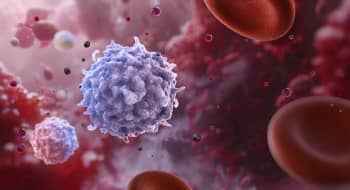
In a healthy body, T-cells are on our side: they search for and destroy threats. But sometimes – such as in Alyssa’s leukaemia – they grow out of control and become cancerous. Professor Qasim wondered: could he use base editing to use their power for good?
“We worked for six years,” he says. “We created our own base-editing tools and refined them over time, achieving ever greater accuracy and efficiency.”
As part of his clinical role, Professor Qasim was spending one day a week looking after children receiving bone marrow transplantation at GOSH. That meant seeing the children for whom transplants didn’t work – like Alyssa. He knew the base-editing technology he and colleagues had been developing might be the last chance she had.
After long discussions with Alyssa and her family, she became the first person enrolled onto a new clinical trial, which was approved by the UK regulator and ethics committees to start on 14 April 2022 at GOSH.
He and his team worked to modify T-cells from a healthy donor. The new cells were edited to stop them attacking a patient’s body, to remove a surface flag called CD7 on all T-cells, and create an ‘invisibility cloak’ that would prevent the new cells being killed by chemotherapy. Finally they were armed with a CAR to recognise, hunt down and kill any cells with the CD7 marking left on – and destroy them.
On 4 May 2022, Alyssa was injected with the modified T-cells, contained in a tiny vial no larger than a stick of lip balm. Just 28 days after receiving that first intervention, her leukaemia was in remission. Soon, her cancer dropped to levels ’below detection’ using the most sensitive lab tests as Professor Qasim wrote in the first account of the study, published in the New England Journal of Medicine.
It’s a remarkable outcome. Young patients in a similar situation face extremely poor prognosis, with less than 15 per cent long-term survival.
This year Professor Qasim – and Alyssa – were hailed on the TIME magazine’s World’s Most Influential Leaders in Health list. But Professor Qasim is quick to credit his colleagues at UCL and GOSH, among them Dr Christos Georgiadis (UCL Department of Infection, Immunity and Inflammation) and Dr Robert Chiesa and Dr David O’Connor at GOSH.
“My inclusion in the list is really down to the work of the amazingly dedicated teams that pull together to find new ways to help patients,” he says.
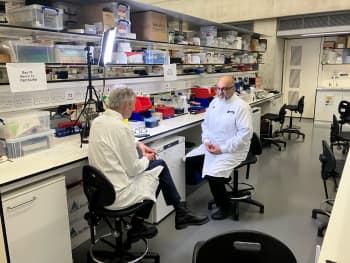
His work continues. “I see myself as a clinician scientist trained in paediatric medicine but devoting most of my time to laboratory research,” he says. But that lab at UCL GOS ICH is also connected to the main hospital by a single corridor. “We move effortlessly between the two,” he says. “There are no other physical or intellectual barriers, so it leads to serendipitous events.”
Indeed, he first heard about Layla Richards from her transplant consultant Prof Paul Veys who set up the unit in the 1990s. “He asked, ‘I might be out of my mind, but could your cells be useful here?’”
That’s the superpower of the UCL GOS ICH, he says: the way it can link cutting-edge technologies in the lab with real results in the hospital for patients.
Though it was Alyssa’s world-first therapy that caught the headlines, eleven patients have now been treated with the base-editing technique, with nine achieving deep remission.
“These are intense and difficult treatments,” Professor Qasim says. “Patients and families have been generous in recognising the importance of learning as much as possible from each experience. We couldn’t do the work we do without people like this. They put their trust and faith in us to push the boundaries of science – when they know there is no guarantee of success. This technology offers hope for the future, but we know there’s more work to be done.”
And Alyssa? She is studying for her A levels, sailing and undertaking the Duke of Edinburgh’s Award, living a normal life – and thinking about how she can, in turn, help others.
“Next on my list is learning to drive,” she says. “But my ultimate goal is to become a research scientist and be part of the next big discovery that can help people like me.”
Portico magazine features stories for and from the UCL community. If you have a story to tell or feedback to share, contact advancement@ucl.ac.uk
Editor: Lauren Cain
Editorial team: Ray Antwi, Rachel Henkels, Harry Latter, Chloe Lambdon, Bryony Merritt, Lucy Morrish, Alex Norton, Thrisha Sajeev
Shorthand presentation: Harpoon Productions
Additional copywriting: YBM
Follow UCL



 Built with Shorthand