
Breakthroughs
Shaping tomorrow
Hidden ecosystems below Antarctica’s ice shelves, the power of shared mealtimes for wellbeing, and the climate impact of massive asteroid collisions. Catch up on the latest breakthroughs from UCL’s faculties.


Features | Portico Magazine | Spring 2025

Breakthroughs
Shaping tomorrow
Hidden ecosystems below Antarctica’s ice shelves, the power of shared mealtimes for wellbeing, and the climate impact of massive asteroid collisions. Catch up on the latest breakthroughs from UCL’s faculties.
Features | Portico Magazine | Spring 2025
Active lifestyle linked to dementia prevention
UCL Faculty of Population Sciences


A smiling couple jogging in the park. Credit: Lordn on iStock
A smiling couple jogging in the park. Credit: Lordn on iStock
People who exercise throughout their lives have a better chance of avoiding dementia – even if they show signs of diseases like Alzheimer’s, finds a new study led by UCL Population Health Sciences researchers.
Published in Brain Communications, the research is part of the Insight46 study, which has tracked the health of over 450 individuals born in 1946. The study examined how patterns of physical activity over three decades influenced brain health and cognitive function at the age of 70.
Findings reveal that regular exercise, particularly before age 50, correlates with a larger hippocampus – the brain region responsible for memory. Notably, participants who maintained consistent physical activity were less likely to experience cognitive decline, even when presenting key Alzheimer's markers such as amyloid build-up and brain shrinkage. This protective effect was especially pronounced in women.
Lead author Dr Sarah-Naomi James (UCL Dementia Research Centre and MRC Unit for Lifelong Health and Ageing at UCL) said: "Our findings show that staying active throughout your life, especially before turning 50, can help keep your brain healthy and delay early signs of Alzheimer's. We hope that our work highlights the critical importance of exercising to support brain health for people of all ages."
The researchers advocate for further studies to identify specific aspects of physical activity that contribute to these protective effects, aiming to inform future interventions for Alzheimer's prevention.
Read the full story: Exercising throughout life could prevent dementia
Life below Antarctica’s ice shelves
UCL's Faculty of Social & Historical Sciences

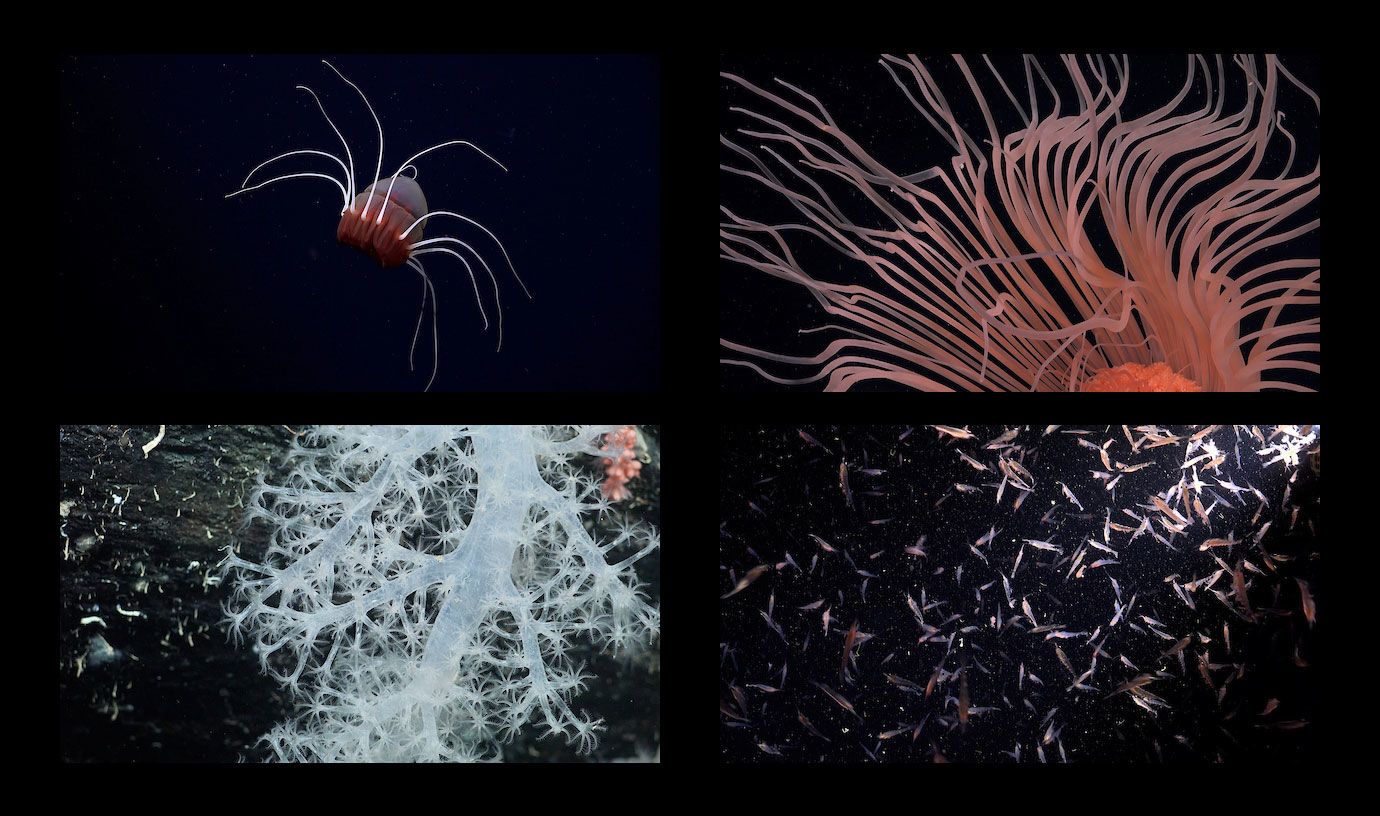
A mixture of marine life, including corals, icefish, giant sea spiders, and octopus. Credit: ROV SuBastian / Schmidt Ocean Institute.
A mixture of marine life, including corals, icefish, giant sea spiders, and octopus. Credit: ROV SuBastian / Schmidt Ocean Institute.
An Antarctic expedition co-led by a UCL Social & Historical Sciences researcher has discovered a diverse marine life ecosystem, that may include previously unknown species, in a region of ocean once hidden under a thick cover of ice.
In December 2024, a colossal iceberg, comparable in size to Chicago, calved from Antarctica's George VI ice shelf, revealing a previously inaccessible marine habitat. The researchers had originally planned to stay farther out in the Bellingshausen Sea to study other ice-shelf systems but instead pounced on the rare opportunity to explore an otherwise inaccessible environment.
Using underwater remotely operated vehicles (ROVs), sonar soundings, sediment coring, water sampling and other techniques, the team spent ten days charting the underwater environment to an unprecedented level of detail.
They found a wide abundance of life below the shelf, including sponges, icefish, giant seaspiders, octopus and large, slow-growing cup corals, some of which may be newly discovered to science. The data and samples collected will likely take years to fully analyse.
Co-leader of the expedition Dr Aleksandr Montelli (UCL Geography) said: “Ice shelves are among the most hostile and most remote environments on the planet. To my knowledge, this is the first comprehensive, interdisciplinary study of this kind to be completed in a sub-ice shelf environment. This work is critical for providing longer-term context of the recent climate changes we are seeing now, and we will undoubtedly make new discoveries as we continue to analyse this vital data.”
Read the full story: Beautiful ecosystem thrives underneath Antarctic ice shelves


Why mealtimes matter
UCL Faculty of Arts & Humanities

A group of friends dining together. Credit: Drazen Zigic on iStock
A group of friends dining together. Credit: Drazen Zigic on iStock
Sharing meals with others is strongly associated with higher life satisfaction and wellbeing, according to a study by UCL researchers for the World Happiness Report.
The research, involving over 150,000 participants from 142 countries, indicates that the frequency of meal sharing is as significant an indicator of self-reported wellbeing as income and employment status.
The study found that individuals who consistently share lunches and dinners rate their life satisfaction more highly compared to those who dine alone. This pattern persists even after accounting for age, gender, income and living arrangements.
Co-author Dr Alberto Prati (UCL Arts & Humanities) remarked: "We knew the importance of social connection to wellbeing, but we were surprised by the strength of the connection between meal sharing and positive life evaluations and emotions."
Geographically, Latin America and the Caribbean lead in meal sharing, averaging nine shared meals per week, compared to 7.5 in the UK. The study also shows a growing trend of solitary dining in the USA, with 26% of adults reporting eating all meals alone on the previous day – a 50% increase since 2003.
The team believe these findings have useful policy implications and highlight the number of shared meals as a promising yet understudied comparative index for social research.
Read the full story: Sharing mealtimes with others linked to better wellbeing
Taxing ‘superprofits’ could fund clean energy future
The Bartlett, UCL Faculty of the Built Environment

The burning chimney of an oil refinery. Credit: pruscha on iStock.
The burning chimney of an oil refinery. Credit: pruscha on iStock.
An international study featuring a UCL Bartlett academic revealed that the 2022 energy crisis led to windfall 'superprofits' for oil and gas companies, amounting to five times the annual international funding commitments for combatting climate change in developing countries.
The study, published in Climate Policy, analysed 93 of the largest fossil fuel companies around the world, focusing on their reported revenues in 2022. Russia invaded Ukraine in February that year, and as a result, international energy prices soared and fossil fuel companies reaped tremendous profits.
By subtracting the companies’ projected earnings from their actual earnings at the year’s end, it was found that they collectively netted nearly half a trillion US dollars ($490 billion) in profits above their expectations.
The majority of countries are not on track to meet their Paris Agreement commitments, with finances often cited as the major stumbling block. But the researchers argue that there is evidently funding available in the hands of fossil fuel companies, and that much of the gap between rhetoric and action could be closed by windfall taxes.
Co-author Professor Michael Grubb (UCL Bartlett School of Environment, Energy and Resources) said: “Taxing ‘superprofits’ could help reduce investment in oil and gas and support the development of a stable and efficient clean energy market. These taxes should be considered for the moral and economic purposes of a managed transition in the global energy system.”
Read the full story: Fossil fuel ‘superprofits’ could have funded international climate finance needs several times over


Hope for preventing Huntington's disease
UCL Faculty of Population Health Sciences

Human brain and DNA helix. Credit: Victor Golmer on iStock.
Human brain and DNA helix. Credit: Victor Golmer on iStock.
A recent study led by UCL Brain Sciences researchers has identified subtle changes in the brain that occur up to two decades before the clinical onset of Huntington’s disease.
Huntington’s disease is a devastating neurodegenerative condition affecting movement, thinking and behaviour. It is a genetic disease caused by the repetitive expansion of three DNA blocks in a specific gene, which accelerates neurodegeneration, making brain cells more vulnerable over time.
The researchers studied 57 people with the Huntington’s disease gene expansion, who were estimated to be on average 23.2 years from a clinical motor diagnosis. By comparing this group with 46 control participants, they were able to demonstrate subtle changes detected in brain scans and spinal fluid biomarkers of those with the Huntington’s disease gene expansion.
Co-first author of the study Dr Rachael Scahill (UCL Huntington’s Disease Research Centre) said: “This unique cohort provides us with unprecedented insights into the very earliest disease processes, showing that the neurodegenerative process begins long before symptoms are evident. This has implications not only for Huntington’s disease but for other neurodegenerative conditions such as Alzheimer’s disease.”
This research could pave the way for future preventative clinical trials and offer hope for earlier interventions to improve outcomes for individuals at risk of Huntington’s disease.
Read the full story: Brain changes in Huntington’s disease decades before diagnosis will guide future prevention trials
The global genetics of depression
UCL Faculty of Life Sciences

Graphic representation of the DNA sequence. Credit: Gio_tto on iStock
Graphic representation of the DNA sequence. Credit: Gio_tto on iStock
The world’s largest and most diverse genetic study into depression, co-led by UCL Life Sciences researchers, has identified nearly 300 previously unknown genetic variants associated with major depression.
By analysing anonymised genetic data from over five million individuals in 29 countries – including significant representation from African, East Asian, Hispanic, and South Asian populations – researchers were able to uncover a total of 700 genetic variations linked to depression. Over 100 of these newly discovered variants were identified due to the inclusion of non-European descent participants, addressing previous biases toward European populations in genetic research.
Each single genetic variant has a small effect on the overall risk of developing depression, but if a person has multiple variants, these effects can add up, increasing their risk. Thanks to identifying these new variants, the research team were able to more accurately predict an individual’s risk of depression.
The identified genetic variants are associated with neurons in multiple brain regions, including those that control emotion, which provides new insights into depression's neurological impact and potential treatment targets.
Joint senior author Professor Karoline Kuchenbaecker (UCL Genetics Institute and UCL Psychiatry) said: “Studies like ours that include data from diverse groups of people are vital to ensure that we are not missing a major piece of the puzzle and that everyone can benefit from the findings of genetic research.”
Read the full story: Global study pinpoints genes for depression across ethnicities

Private schools lose GCSE advantage
IOE, UCL Faculty of Education and Society

Students sitting exams in a school hall. Credit: monkeybusinessimages on iStock
Students sitting exams in a school hall. Credit: monkeybusinessimages on iStock
When adjusted for socioeconomic background, private school pupils in England no longer outperform their state school counterparts in core GCSE subjects, according to a new study by researchers from the IOE, UCL’s Faculty of Education and Society.
The researchers used longitudinal data from the UK Millenium Cohort Study to understand GCSE performance differences alongside characteristics such as family income, parental occupation status, home ownership, gender, ethnicity and geography.
Before adjusting for socioeconomic background, private school pupils achieved on average over four fifths (83%) of a grade higher across all GCSE subjects. Once socioeconomic status was accounted for, this difference was close to, and statistically indistinguishable from, zero.
Notably, after accounting for socioeconomic status, state school students scored two-thirds (66%) of a grade higher in Maths and two-fifths (41%) higher in Science. However, on average private school students continue to score just over half a grade higher in creative subjects like Music, Drama and Art, even after adjusting.
Lead author Professor Jake Anders (UCL Centre for Education Policy & Equalising Opportunities) said: “While it is positive for social mobility that state schools are producing stronger results in the core subjects, inequality still exists – and is arguably becoming more pronounced – in industries such as acting, music and art. State school alumni’s disadvantages in the creative world will not diminish until this gap starts to be reduced.”
Read the full story: Private schools lose GCSE results edge after socioeconomic adjusting
Did asteroids alter Earth’s climate?
UCL Faculty of Mathematical and Physical Sciences


Illustration of a meteorite falling towards planet Earth. Credit: dottedhippo on iStock
Illustration of a meteorite falling towards planet Earth. Credit: dottedhippo on iStock
Two massive asteroid impacts approximately 35.65 million years ago did not lead to long-term climate changes on Earth, according to a new study by UCL Mathematical and Physical Sciences researchers.
The rocks, both several miles wide, hit Earth about 25,000 years apart, leaving the 100km-wide Popigai crater in Siberia and the 40-85km Chesapeake Bay crater in the United States.
The research team analysed carbon and oxygen isotopes in over 1,500 fossils of single-celled organisms. The fossils ranged from 35.5 to 35.9 million years old and were found in a rock core from underneath the Gulf of Mexico.
Previous studies into the climate of this time had been inconclusive, with some linking the asteroid impacts with accelerated cooling and others with episodes of warmer temperatures. However, by studying fossils that lived at a range of ocean depths, the research team were able to build a more complete picture of how the planet responded to the impacts.
Professor Bridget Wade (UCL Earth Sciences), a co-author of the study, commented: “What is remarkable is that there were no significant climate shifts in the 150,000 years following the impacts. We expected the isotopes to shift in one direction or another, indicating warmer or cooler waters, but this did not happen.”
The study suggests that while these asteroid impacts would have caused immediate catastrophic effects, including shockwaves, tsunamis and atmospheric dust blocking sunlight, these did not translate into prolonged climatic alterations. The findings underscore the resilience of Earth's climate system to massive extraterrestrial impacts over extended timescales.
Read the full story: Massive asteroid impacts did not change Earth’s climate in the long term


The material that could transform electronics
UCL Faculty of Engineering Sciences

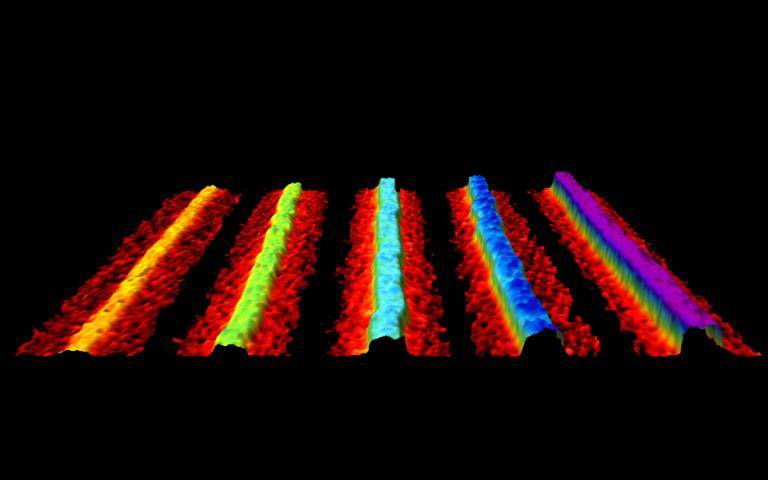
Individual phosphorene nanoribbons. Credit: Watts et al.
Individual phosphorene nanoribbons. Credit: Watts et al.
Researchers from UCL Engineering and UCL Mathematical and Physical Sciences, in collaboration with the University of Cambridge and other universities, have demonstrated that phosphorene nanoribbons – one-atom-thick strips of crystalline phosphorus – exhibit both magnetic and semiconducting properties at room temperature.
This discovery positions these nanoribbons as a unique class of material with the potential to enable more energy-efficient computing and unlock new quantum technologies.
The one-atom-thick ribbons display macroscopic magnetic properties similar to traditional magnetic metals such as iron and nickel. These properties open new possibilities for electronic circuits, where magnetic properties could be used to manipulate the electronic states in a low-energy way. This could also lead to faster storage devices where light is used to switch the magnetic state.
The UCL team, who initially discovered the phosphorene nanoribbons in 2019, had already shown that the nanoribbons could be alloyed with arsenic to modify their properties, and also that they could be used to improve the efficiency of solar cells.
This work is particularly significant as it marks the first experimental validations of the predicted but difficult to observe magnetic properties of phosphorene nanoribbons. The next steps of the research involve finding ways to study the coupling of magnetism with light and vibrations on the edge of these ribbons and exploring their potential to develop entirely new device concepts.
Read the full story: Phosphorene nanoribbons show their potential for revolutionising electronics
New treatment redefines care for aggressive blood cancer
UCL Faculty of Medical Sciences
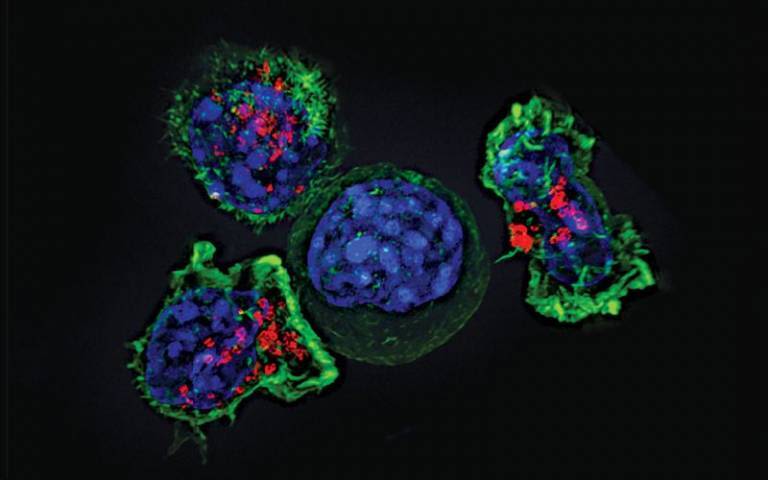
Killer T cells surround a cancer cell. Credit: Alex Ritter, Jennifer Lippincott Schwartz and Gillian Griffiths, National Institutes of Health (CC BY 2.0)
Illustration of a meteorite falling towards planet Earth. Credit: dottedhippo on iStock
A clinical trial led by UCL Medical Sciences and UCLH has demonstrated that a new T-cell (CAR-T) therapy offers promising results for patients with specific types of leukaemia.
The FELIX trial, involving 127 adult patients across the UK, Europe and the USA, reported a 74.7% remission rate following the new therapy known as obecabtagene autoleucel (obe-cel). Estimates suggest that after six months, 65.4% of patients would be alive and disease-free, with 49.5% maintaining this status after 12 months.
Obe-cel was engineered by scientists at the UCL Cancer Institute to improve existing CAR-T therapies for relapsed or refractory B-cell acute lymphoblastic leukaemia (r/r B-ALL). Existing treatments commonly cause severe immune-related side effects, high toxicity and do not stay active in the body for long enough to be highly effective.
“These issues can lead to relapse and poor long-term outcomes,” explained Dr Claire Roddie (UCL Cancer Institute and UCLH), lead investigator of the FELIX trial. “So, Obe-cel was designed to address these limitations, and we are pleased that the trial results indicate that obe-cel is both highly effective and has a favourable safety profile.”
By modifying the engagement duration between CAR-T cells and their targets, obe-cel reduces inflammation and enhances cell longevity, thereby decreasing relapse rates.
The findings suggest that obe-cel could become a new standard of care for r/r B-ALL, offering a more effective and safer treatment option for patients with this aggressive blood cancer.
Read the full story: New CAR-T cell therapy gives hope for patients with aggressive blood cancer

Legal challenge forces Council to reveal hidden housing policy
UCL Faculty of Laws


An apartment building in Hackney, London. Credit: Samuel Regan-Asante on Unsplash
An apartment building in Hackney, London. Credit: Samuel Regan-Asante on Unsplash
Hackney Council has settled a judicial review brought by the UCL Integrated Advice Clinic (iLAC) on behalf of an applicant who was removed from the social housing register which he had been on since 2016.
Thul Khan, Solicitor at the UCL Legal Advice Clinic, and UCL Laws alumnus Jeremy Ogilvie-Harris challenged the decision, arguing it was unlawful.
The client – living in overcrowded accommodation with his partner and two teenage children – was removed from the register after changes to eligibility criteria were introduced.
Khan and Ogilvie-Harris argued that tenants were not provided with a clear timeframe for the transitionary period, and that the Council relied on unpublished guidance and key policy information used to decide who qualifies for social housing.
As a result of the legal claim, Hackney Council agreed to reinstate the Claimant to the housing register, disclose the unpublished guidance and commit to a wider review of its approach.
The litigation is part of a wider UCL Laws research initiative exploring how local government practices can undermine access to justice, especially in housing and welfare contexts. The case underscores how legal tools can help improve transparency, accountability and fairness in systems that determine life-changing outcomes.
Read the full story: Hackney Council concedes claim arguing unpublished housing allocations guidance is unlawful


Portico magazine features stories for and from the UCL community. If you have a story to tell or feedback to share, contact advancement@ucl.ac.uk
Editor: Lauren Cain
Editorial team: Ray Antwi, Laili Kwok, Harry Latter, Bryony Merritt, Lucy Morrish, Alex Norton
Shorthand presentation: Harpoon Productions
Additional design support: Boyle&Perks
Follow UCL


 Built with Shorthand