


Spotlight | Portico Magazine | Autumn 2025
Spotlight:
The Ceremonial Mace of UCL
UCL’s ceremonial mace, a fixture at every graduation ceremony, quietly tells the story of the university’s radical roots and long-standing tradition of philanthropy.


Spotlight | Portico Magazine | Autumn 2025
Spotlight:
The Ceremonial Mace of UCL
UCL’s ceremonial mace, a fixture at every graduation ceremony, quietly tells the story of the university’s radical roots and long-standing tradition of philanthropy.
When you think of graduation, what probably comes to mind first is the hard work behind your degree, the proud moment of crossing the stage, raised mortarboards, heartfelt speeches and celebrating with friends and family.
What you may not immediately recall is UCL’s ceremonial mace. And yet, if you graduated from UCL in the last 30 years or so, it was almost certainly there with you.


When you think of graduation, what probably comes to mind first is the hard work behind your degree, the proud moment of crossing the stage, raised mortarboards, heartfelt speeches and celebrating with friends and family.
What you may not immediately recall is UCL’s ceremonial mace. And yet, if you graduated from UCL in the last 30 years or so, it was almost certainly there with you.
Like at many universities in the UK and around the world, the ceremonial mace plays a central role in UCL’s official events and holds rich institutional significance. Symbolising the authority of an institution or individual, ceremonial maces are also used in Parliament, civic parades and royal events such as coronations.
The mace became part of UCL’s graduation ceremonies following its creation in 1993. It is carried by the Ceremonial Beadle, who leads the academic procession to and from the stage. It also features in the conferral of honorary degrees.
More than just a decorative object at graduation, this ornamental staff is a powerful emblem of UCL’s academic heritage. Once on stage, the mace is placed on a stand at the front and centre, where it remains throughout the ceremony – a quiet but constant presence.

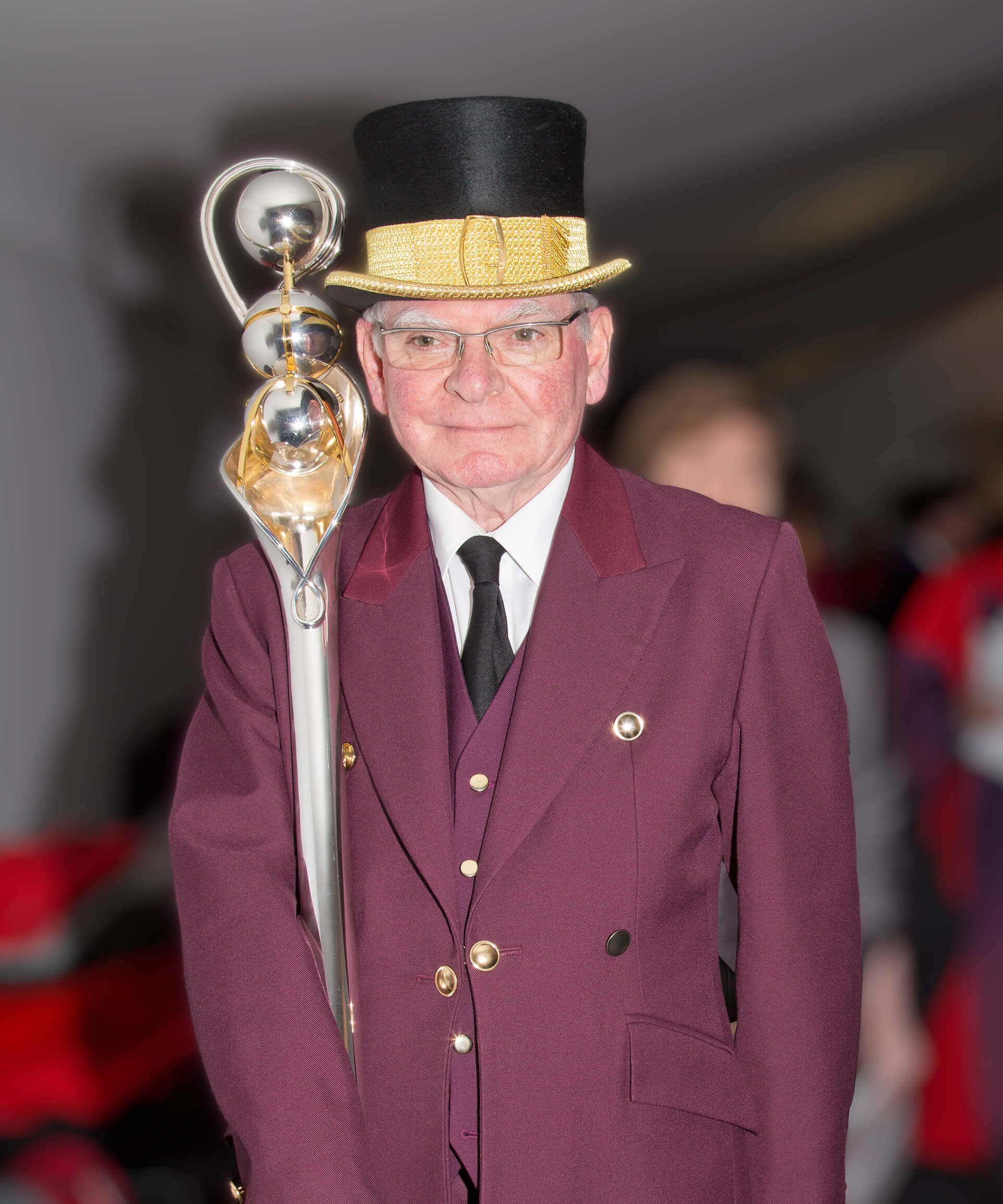

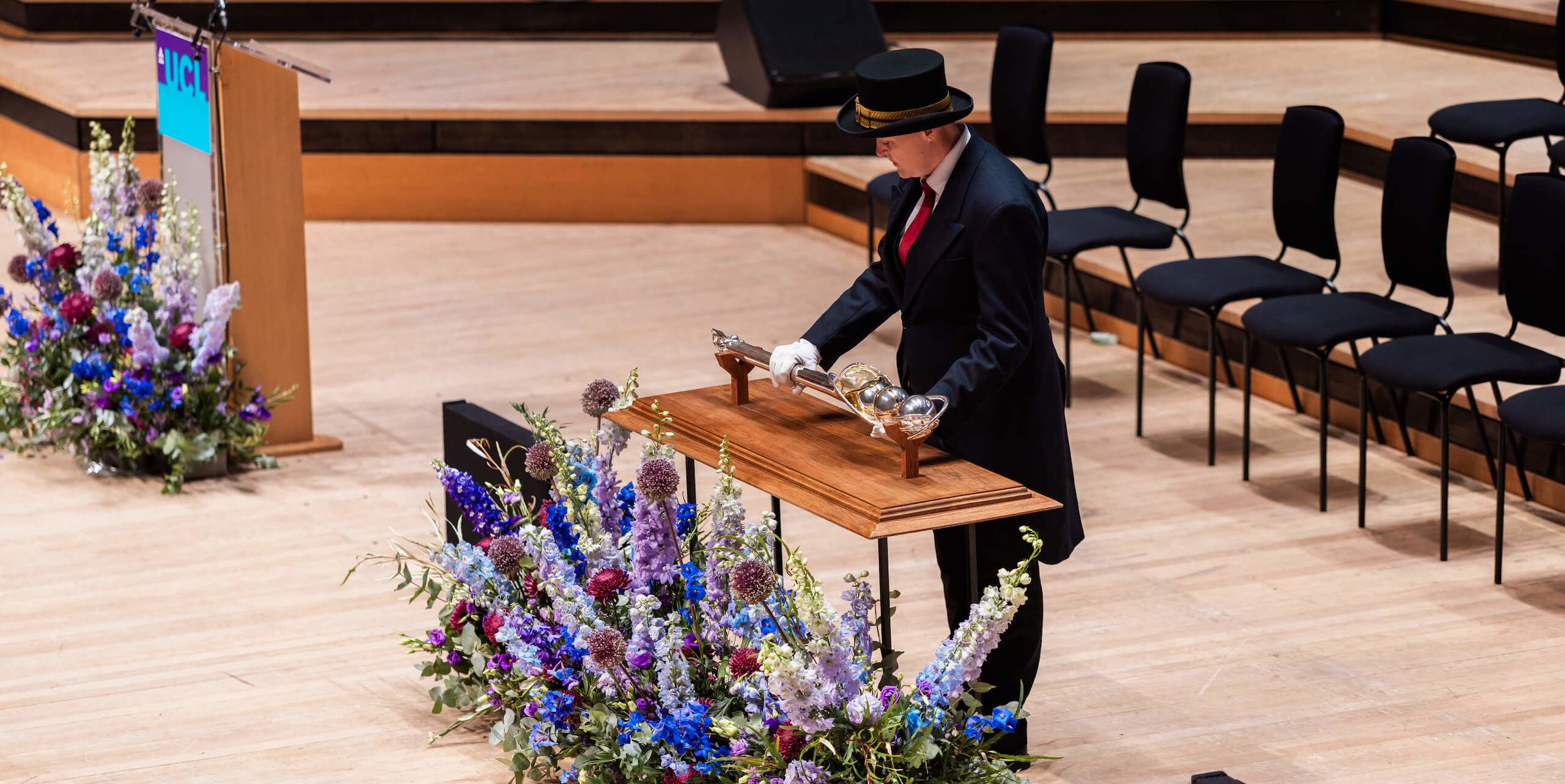


It symbolises the university’s authority to confer degrees and represents the power of the Provost, affirming their role and independence from external influence.


It symbolises the university’s authority to confer degrees and represents the power of the Provost, affirming their role and independence from external influence.
The alum who brought it to life


The mace was crafted in 1993 by alum Tom Lomax (UCL Higher Diploma in Fine Art 1976), who went on to tutor at the Slade School of Fine Art from 1982.
A sculptor by specialism, he retired from teaching in 2010. He is the artist behind an array of significant public art commissions, including Spirit of Enterprise, a bronze sculpture formerly located in Birmingham’s Centenary Square.



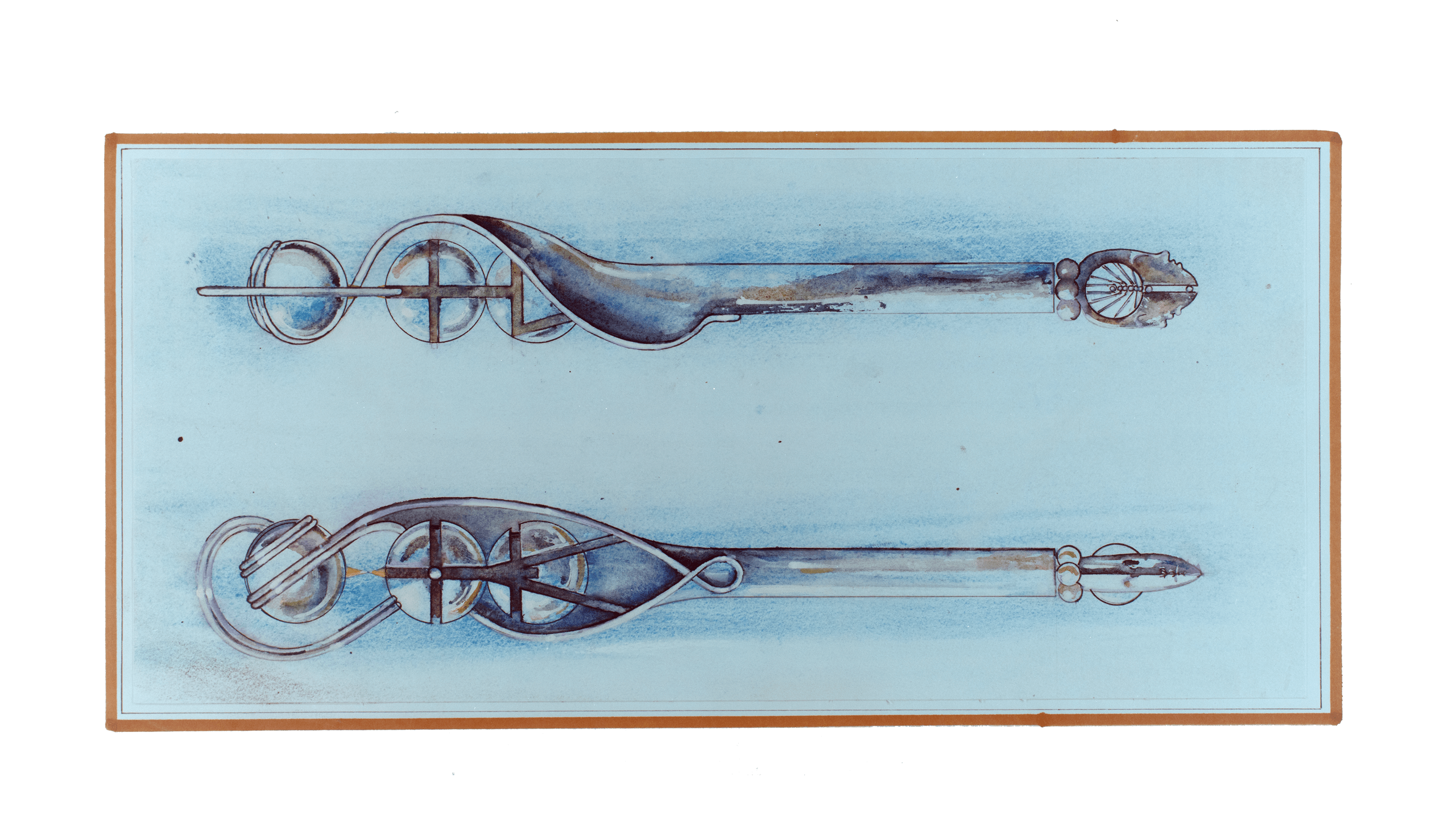
An original sketch of the mace design
An original sketch of the mace design
A symbol of UCL’s radical roots
Deeply personal to UCL, Lomax’s design echoes the university’s history and ethos, particularly the tradition of social radicalism.
From UCL’s foundation in 1826, we embraced a progressive and pioneering spirit, becoming the first university in England to welcome students regardless of religion or social background. In 1878, UCL took another step by becoming the first university in England to admit women as full-time degree students in two of our principal faculties: Laws and Science & Arts. This marked the first time in Britain that women gained full access to university education.
This move towards gender equality is expressed in the mace’s design. Inside the lily-shaped handle are two orbs: it is thought one represents the Faculty of Arts, the other the Faculty of Laws: the faculties women could first call home. A third, separate orb represents the Faculty of Science.
Embellished across all three orbs is an intricate design of the male and female symbols, signifying the coming together of men’s and women’s intellects at UCL.
Lomax’s sweeping lines on the mace handle echo a lily, a traditional symbol of purity and beauty.
As Lomax once described it, the design is intended to be open to interpretation: “Something that encourages the viewer to make their own interpretation of the mace’s meaning through their experience at UCL, and how the university’s ethos has influenced them.”
From UCL’s foundation in 1826, we embraced a progressive and pioneering spirit, becoming the first university in England to welcome students regardless of religion or social background. In 1878, UCL took another step by becoming the first university in England to admit women as full-time degree students in two of our principal faculties: Laws and Science & Arts. This marked the first time in Britain that women gained full access to university education.
This move towards gender equality is expressed in the mace’s design. Inside the lily-shaped handle are two orbs: it is thought one represents the Faculty of Arts, the other the Faculty of Laws: the faculties women could first call home. A third, separate orb represents the Faculty of Science.
Embellished across all three orbs is an intricate design of the male and female symbols, signifying the coming together of men’s and women’s intellects at UCL.
Lomax’s sweeping lines on the mace handle echo a lily, a traditional symbol of purity and beauty.
As Lomax once described it, the design is intended to be open to interpretation: “Something that encourages the viewer to make their own interpretation of the mace’s meaning through their experience at UCL, and how the university’s ethos has influenced them.”
Sculpted by philanthropy
The creation of the mace was funded by the UCL Friends’ Trust, a network of philanthropists who support UCL to further both the institution and our students’ success.
Established in 1953, the UCL Friends’ Trust provides grants to students, societies, clubs and student-led projects that make a meaningful impact on life at UCL. Past support has included funding for new equipment, innovative initiatives and enriching one-off events, supporting thousands of students across the full spectrum of extracurricular activities.
This gift from the UCL Friends’ Trust continues a long tradition of generous giving to UCL in support of our students. The creation of UCL itself, in 1826, was a bold act of philanthropy, made possible by the generosity of founders and benefactors who sought to create a radical alternative to the Church of England–only universities of Oxford and Cambridge. Philanthropy enabled UCL, from our very foundation, to be different: to think differently, to act differently and to challenge the status quo. It is a history that the mace visually expresses.
Sculpted by philanthropy
The creation of the mace was funded by the UCL Friends’ Trust, a network of philanthropists who support UCL to further both the institution and our students’ success.
Established in 1953, the UCL Friends’ Trust provides grants to students, societies, clubs and student-led projects that make a meaningful impact on life at UCL. Past support has included funding for new equipment, innovative initiatives and enriching one-off events, supporting thousands of students across the full spectrum of extracurricular activities.
This gift from the UCL Friends’ Trust continues a long tradition of generous giving to UCL in support of our students. The creation of UCL itself, in 1826, was a bold act of philanthropy, made possible by the generosity of founders and benefactors who sought to create a radical alternative to the Church of England–only universities of Oxford and Cambridge. Philanthropy enabled UCL, from our very foundation, to be different: to think differently, to act differently and to challenge the status quo. It is a history that the mace visually expresses.
It is fitting, then, that those donors who have gone above and beyond, giving more than £1 million to UCL and forming part of the Circle of Benefactors (UCL’s first-ever £1m+ donor recognition group, launched in 2017), are presented with a miniature mace: a replica of the UCL ceremonial mace, symbolising the university’s profound gratitude for their substantial support.

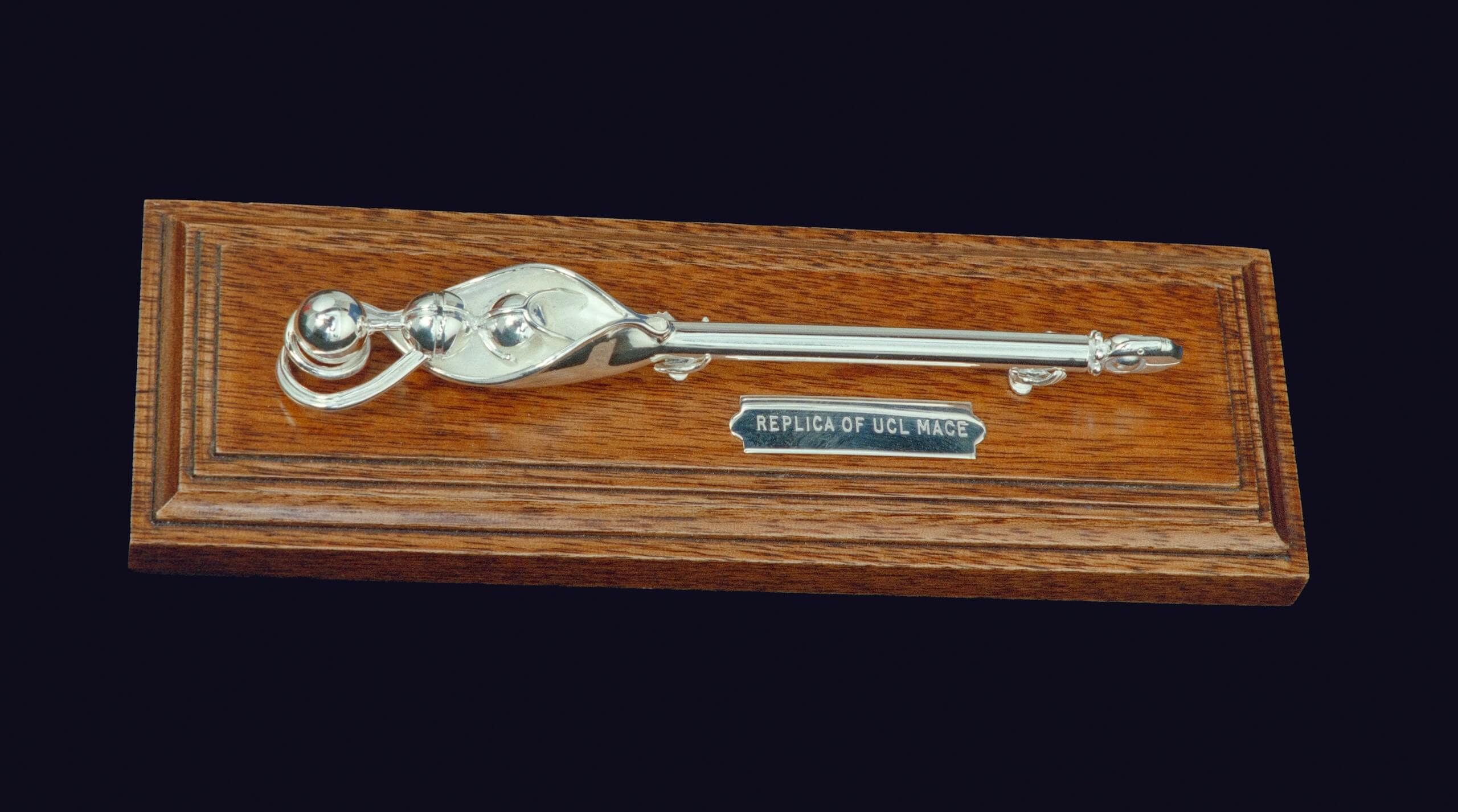
Members of the Circle range from individuals and family-run trusts and foundations to national and international businesses and charities. Their impact is wide-ranging, from the Pears Foundation’s support to create the UCL Centre for Holocaust Education, to a coalition of major retailers such as Iceland, Asda and Waitrose, who donated proceeds from the 5p plastic bag levy to collectively give £20 million to advance dementia research.
It is fitting, then, that those donors who have gone above and beyond, giving more than £1 million to UCL and forming part of the Circle of Benefactors (UCL’s first-ever £1m+ donor recognition group, launched in 2017), are presented with a miniature mace: a replica of the UCL ceremonial mace, symbolising the university’s profound gratitude for their substantial support.
Members of the Circle range from individuals and family-run trusts and foundations to national and international businesses and charities. Their impact is wide-ranging, from the Pears Foundation’s support to create the UCL Centre for Holocaust Education, to a coalition of major retailers such as Iceland, Asda and Waitrose, who donated proceeds from the 5p plastic bag levy to collectively give £20 million to advance dementia research.
Philanthropy enabled UCL, from our foundation, to be different: to think differently, to act differently and to challenge the status quo. It is a history that the mace visually expresses.
Portico magazine features stories for and from the UCL community. If you have a story to tell or feedback to share, contact advancement@ucl.ac.uk
Editor: Lauren Cain
Editorial team: Ray Antwi, Rachel Henkels, Harry Latter, Bryony Merritt, Lucy Morrish, Alex Norton
Shorthand presentation: Harpoon Productions
Additional design support: Boyle&Perks
Follow UCL


 Built with Shorthand