





Features | Portico Magazine | Autumn 2025
Designing healthier places
For better or worse, our environments shape us. Researchers from UCL’s The Bartlett are uncovering new ways for our built environment to support – and improve – our health and wellbeing.
What impact do the places and spaces where we spend our time have on our health and wellbeing?
It’s a question that sits at the heart of the work of a group of committed academics at The Bartlett Faculty of the Built Environment – who are combining architectural expertise (and their own lived experiences) with inspiration from neuroscience, political theory, sociology and even meteorology.




Features | Portico Magazine | Autumn 2025
Designing healthier places
For better or worse, our environments shape us. Researchers from UCL’s The Bartlett are uncovering new ways for our built environment to support – and improve – our health and wellbeing.
What impact do the places and spaces where we spend our time have on our health and wellbeing?
It’s a question that sits at the heart of the work of a group of pioneering academics at The Bartlett Faculty of the Built Environment - who are combining architectural expertise (and their own lived experiences) with inspiration from neuroscience, political theory, sociology and even meteorology.
From built environment research that demonstrates the harm inflicted on vulnerable communities in war-torn places, to exploring the psychological differences between individuals’ spatial experiences – these new ‘place and space’ projects are helping to find new ways to design environments that truly serve the needs of the people who use them.


Connecting planning to purpose
Kerstin Sailer is Professor in the Sociology of Architecture at UCL's Bartlett School of Architecture
I’m a sociologist at heart. I've always been interested in user experience. When you combine that with architecture, it means you can move past questions like, ‘how do we design best?’, or ‘what kind of material structures do we need to construct?’, to ask instead, ‘how will this affect people?’







My research draws heavily on space syntax theory, which was pioneered here at The Bartlett in the late 1970s by Professor Bill Hillier and Professor Julienne Hanson.
Space syntax allows us to understand how built environments function as a network. We can then explore the connections between different points of the network, and the way people move through these connections.
Space syntax is more commonly applied to outdoor urban environments – mainly due to data availability. But there’s a lot we can learn from applying these theories indoors.
With indoor space syntax, you have to be very specific about purposes, and how they match to the spatial environment. What does the building try to achieve? What do the organisations and the people working in these buildings try to achieve?
Our work in healthcare spaces has shown us how important lines of sight and lines of movement are.
Healthcare spaces are really dynamic places. Nurses and healthcare professionals are moving all the time, in and out of patient spaces, picking up medication, to and from the nursing station. All of these paths are incredibly important – what the nurses can see on these paths shapes their communication and behaviour.
In these settings, the openness of the corridors is a big factor in the quality of the communication – and then that communication translates into quality of care.
Quite often in traditional architecture, the corridor is a really undervalued space. It’s almost like the leftover – no designer ever gets told, ‘can you design a great corridor for us?’ But actually, they’re not left over. They’re fundamental to how these buildings operate and work.
I’m currently applying these research approaches to explore the diversity of bodies and minds and experiences.
This direction has partly been influenced by my own experiences with Long Covid. After returning to work, I realised that the big open staircase at The Bartlett was no longer for me. It was always my favourite part of the building, where you connect with other people, and it opens up into all sorts of other places.

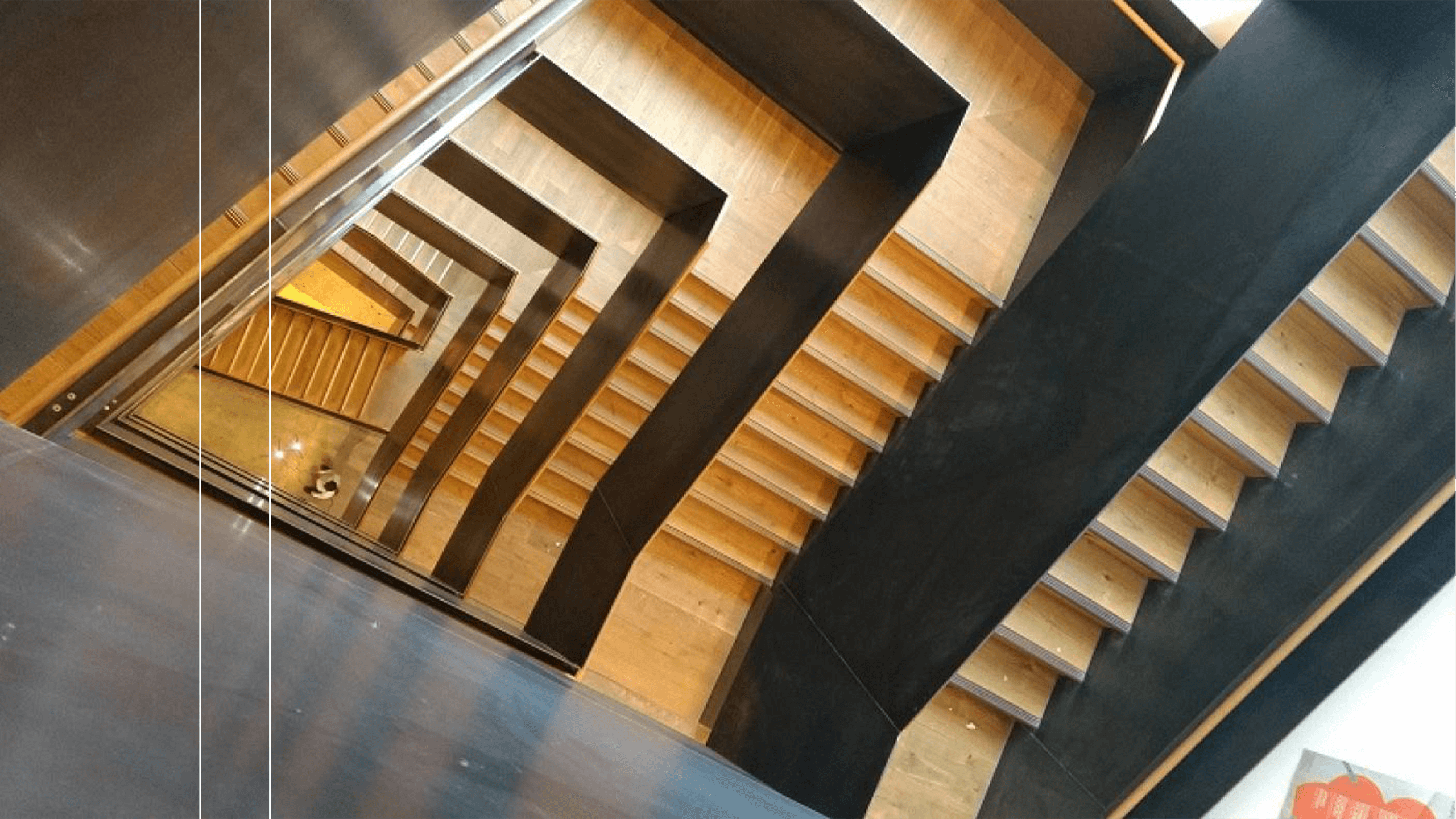
But now, it’s almost become my enemy. There’s no way I can walk up three flights of stairs. Instead I use the lift, and in the process, I’m becoming less visible to others. So I started looking into disabled user experiences. What spaces are accessible? How do visually impaired people navigate buildings and spaces?
For our latest project, we’ve had eight disabled artists and designers walking through a building and describing their viewpoints. Now we’re trying to find ways to model that – using space syntax tools to express those inequalities of experience, moving syntactic expression beyond paradigms of sight and movement.


How neuroscience is helping us understand different experiences of spaces
Dr Fiona Zisch is an Associate Professor at The Bartlett School of Architecture. Along with Professor Hugo Spiers and Isabelle Sjövall, she is a founder and director of the International Centre for NeuroArchitecture and NeuroDesign, a collaboration between UCL and the Research Institutes of Sweden (RISE).
Individuals are incredibly diverse – in terms of their behaviour, psychology, physiology. There are sometimes quite profound differences in how people experience and navigate the world.


The more data and knowledge we have about differences, the better we can understand and design spaces that work for everyone.
That’s what is at the heart of what we are doing at the International Centre for NeuroArchitecture and NeuroDesign.
UCL has a rich history of research in both neuroscience and the built environment, as well as their intersection, recently known as neuroarchitecture. It’s very natural and logical that we are now working to develop a cross-faculty home for this research, for example by taking the areas of neuroscience that relate to spatial cognition, navigation, perception, or individual differences and combining this with architecture and design in both theory and process.
The centre is not just cross-faculty; we’re international and cross-institutional – working in partnership with RISE Research Institutes of Sweden, the Swedish government-run research institute, as our research partner.
Among many developments that have supported an increase in capability is that neurotech is getting so much better – there are so many possibilities we could never have explored even a few years ago. We’re no longer always confined to a lab space; we can now do things in a more robust mobile way, out in the world.
For example, we can use mobile electroencephalography (EEG) to measure activity in people’s brains as they experience spatial environments. There are lots of other physiological measurements we can make too, like heart rate, heart rate variability or eye tracking among others.
Those things are all very exciting, but it’s crucial we ask people, too. If you do this in a systematic way, that is also vital data.






Using interviews, questionnaires, and surveys, we can map people’s responses and psychology over the course of a project, to understand at a deep level how they are feeling or what they are thinking. As an example, Isabelle Sjövall has here developed the NeuroDesign / NeuroArchitecture Index (NDIX), which can be employed in studies that we – and others – run.
Despite the importance and potentials of conducting research out in the world, running experiments in lab environments still remains crucial. Here, we can, for example, repeat experiments in ways that would not be possible out in the world, as we do not have the same level of control of the environment there. We can also manipulate aspects of the environment to test the impact certain changes have. One example of one of our lab based studies is at UCL PEARL, the 100 Minds in Motion project, which is ongoing.
Among the different research strands we are interested in, we have several different healthcare and wellbeing-related workstreams running. For example, I’m working with the UCL Queen Square Institute of Neurology to explore how immersive environments can support stroke rehabilitation.
Professor Hugo Spiers is also investigating how dementia affects the brain’s ability to navigate. Hopefully we can take what we learn from those studies, and find ways to design environments that are easier to navigate – not just for dementia patients, but for everyone else, too.
We’re also in the early stages of a UCL Grand Challenges project looking at how our mental health and wellbeing are affected by different aspects of our working environment – things like light, acoustics, spatial configurations. With a group of UCL and external collaborators, we’ll be working with Kerstin Sailer on this project, and build on the extensive work she’s already done around work environments.
There’s a strong theme of sustainability running through our work at the Centre for NeuroArchitecture and NeuroDesign. In so many different ways, our environments have an impact on us and designing them well impacts how sustainable they are both short and long term.
Spaces can both increase our quality of life or make us quite unwell at times. If we design environments that support us, and are healthier for people to live and work in, for example our healthcare systems won’t have to bear as much impact.
Ultimately, if we think ahead in the way we design proactively, there will be less need for reactive adaptation later. And if we can show the benefits of thinking ahead, maybe other sectors might take notice, too.
Taking the temperature of the cities
Dr Clare Heaviside is an Associate Professor in Climate Change, Health and Cities in the UCL Institute for Environmental Design and Engineering.
My research focuses on the impacts of our environment, and climate change, on the health of people, particularly those living in cities.



If people are ill, or they have an underlying health condition, then higher temperatures can exacerbate symptoms and increase the risk of death.
To investigate health risks from heat, we need to understand variations in outdoor temperatures – especially in cities, which tend to be hotter than rural areas because of all the urban material and the lack of moisture, a phenomenon known as the Urban Heat Island effect. Of course we spend most of our time indoors, but outdoor workers may suffer directly from overheating, and outdoor temperatures are strongly related to indoor temperatures.
We’re working with local authorities in the UK to help them assess their options for introducing climate adaptation measures to mitigate the impact of hot weather on vulnerable communities in their local population, and make cities more resilient.
We use regional climate models (evaluated against meteorological data from local citizen weather stations and Met Office stations) to try to gauge the effect of urban parameters like the density of buildings or the amount of green space or trees on the local climate and temperature.
Then we can run our regional climate models with different urban adaptations like ‘cool’ (reflective) roofs, more trees or increased green areas, to estimate the reduction in population exposures to heat which each adaptation would deliver. That lets us calculate the potential health benefits of the different interventions in terms of avoided heat-related mortality.
Local context is crucial – not just the local climate in the city you’re interested in, but also the type of housing, amount of greenery, and the prevalence of air conditioning. The aim is to target the right measures for specific parts of cities, so that interventions benefit heat-vulnerable groups such as older people living in care homes or social housing.
We can definitely learn from things that have been implemented in other countries. For example, in many Mediterranean countries with a hotter climate, buildings are often painted white, to reflect the heat, and have external shutters on windows. Cool roof surfaces are another effective variation on this approach, as they reflect sunlight away.
Shutters could also be useful for the UK, as a relatively low-cost measure that block heat before it even gets into the building.


We know that air conditioning is effective at reducing indoor temperatures and protecting people against heat exposure effects. But those of us studying the outdoor urban environment can see that along with the environmental costs of generating the energy for air conditioning (if fossil fuels are used), there are also local emissions of waste heat that raise the temperature of the local atmosphere around air-conditioned buildings.
So potentially, those who can afford air conditioning are putting waste heat into the environment, increasing the heat exposure for those living nearby who can’t afford it. That gives us an equity issue to consider.
We’re trying to focus our impact both nationally and regionally. Local authorities have got limited budgets and, wherever possible, they’re trying to tackle mitigation and adaptation at the same time. They don’t want to be doing extensive net zero retrofitting to insulate against the cold, only to find out the buildings are overheating.


Choosing who’s allowed to be healthy, with the politics of urban health and design
Haim Yacobi is a Professor of Development Planning, specialising in critical urban studies and urban health.
Health is political. There are always political choices to be made, whether we’re developing health services, or creating urban design interventions to improve green (land-based) and blue (water-based) infrastructure.






There are positive examples of politically motivated urban health interventions. Places like Copenhagen, for example, have been investing in biking lanes and green spaces since the mid-1970s, as well as efficient public transportation. Given enough time, we’ve consistently seen this kind of intervention lead to measurable improvement in health and mental health, and a reduction in private car usage.
Much of my academic work in the last five years has focused on the politics of health in Gaza. My last research project in Gaza, supported by the Wellcome Trust, enabled me to work with Dr Yasser Abu Jammel from the Gaza Community Mental Health Programme. This project ended two weeks before the terrible war started. In this project we were trying to understand how violence and a sense of hope or hopelessness affect young people in Gaza.
Over many years, there has been a slow deterioration of the environmental and physical conditions of the entire Gaza Strip, primarily due to urban infrastructure being a target during conflict. Based on the interviews and the surveys we carried out, what became very clear was that, even before the last war, there was very little health infrastructure.
This affects not just physical health, but mental health – especially of young people. And it became apparent that people are prevented from developing a sense of the future in these conditions. They can’t think about what they’ll do when they grow up, which is an essential prerequisite for mental health in young people.
Spatial injustice isn’t only to be found in contested spaces. Infrastructure everywhere is shaped by ideological agendas – not just in the Global South, but in the Global North as well.
The question that we architects, planners and development experts need to ask ourselves is, ‘who is the client?’. Not ‘who is paying for the work’, but ‘for whom are we planning?’. Will this development increase social justice? Or the opposite?
Today, I ask myself these questions while working with my colleague Professor Omar Dajani on a three-year project to develop future scenarios for Palestine and Israel beyond the two-state solution. As part of that project, we’re looking at how environmental and health policies could be used to integrate the two sides, rather than separating them.


Portico magazine features stories for and from the UCL community. If you have a story to tell or feedback to share, contact advancement@ucl.ac.uk
Editor: Lauren Cain
Editorial team: Ray Antwi, Rachel Henkels, Harry Latter, Bryony Merritt, Lucy Morrish, Alex Norton
Shorthand presentation: Harpoon Productions
Additional design support: Boyle&Perks
Follow UCL


 Built with Shorthand